The Last Bottleneck
We know how diseases work. We know how to fix them. What we don't have is enough scientists.
We believe disease can be understood. Not just catalogued or correlated—actually understood. At the level of molecular mechanisms. At the level of systems biology. At the level where you can see exactly how a healthy cell becomes a sick one, and design a molecule that reverses that transition.
This is the vision that drives us: to understand disease better than it's ever been understood before, and to translate that understanding into therapies that work. Small molecule drugs—cheap to manufacture, easy to administer, accessible to everyone. Not treatments for the privileged few. Medicine for the world.
The question was always: how do you get there?
The Bet We Made
Nearly a decade ago, we started building. Not better interfaces for existing workflows. The actual computational machinery of discovery.
We built systems to reverse-engineer disease from multi-omics data—to find the precise molecular signatures that distinguish sick tissue from healthy tissue. We built tools to design molecules that selectively shift those signatures back to normal, nudging cells toward health without disrupting what's already working. We built computational models of patients that predict drug response before we synthesize a single compound.
These tools work. They've produced therapeutic candidates now advancing through our pipeline. They achieve best-in-class performance in understanding disease mechanisms. But they were always constrained by how fast our team could operate them.
Then came the breakthrough.
An AI That Does The Work
Large language models can reason. Not just about text—about biology. They can read papers, form hypotheses, design experiments, interpret results. They can write code, build analytical pipelines, train machine learning models. They can do the cognitive work of a scientist.
When we connected foundation models to our discovery infrastructure, something qualitatively new emerged. Not AI-assisted drug discovery. AI-driven drug discovery.
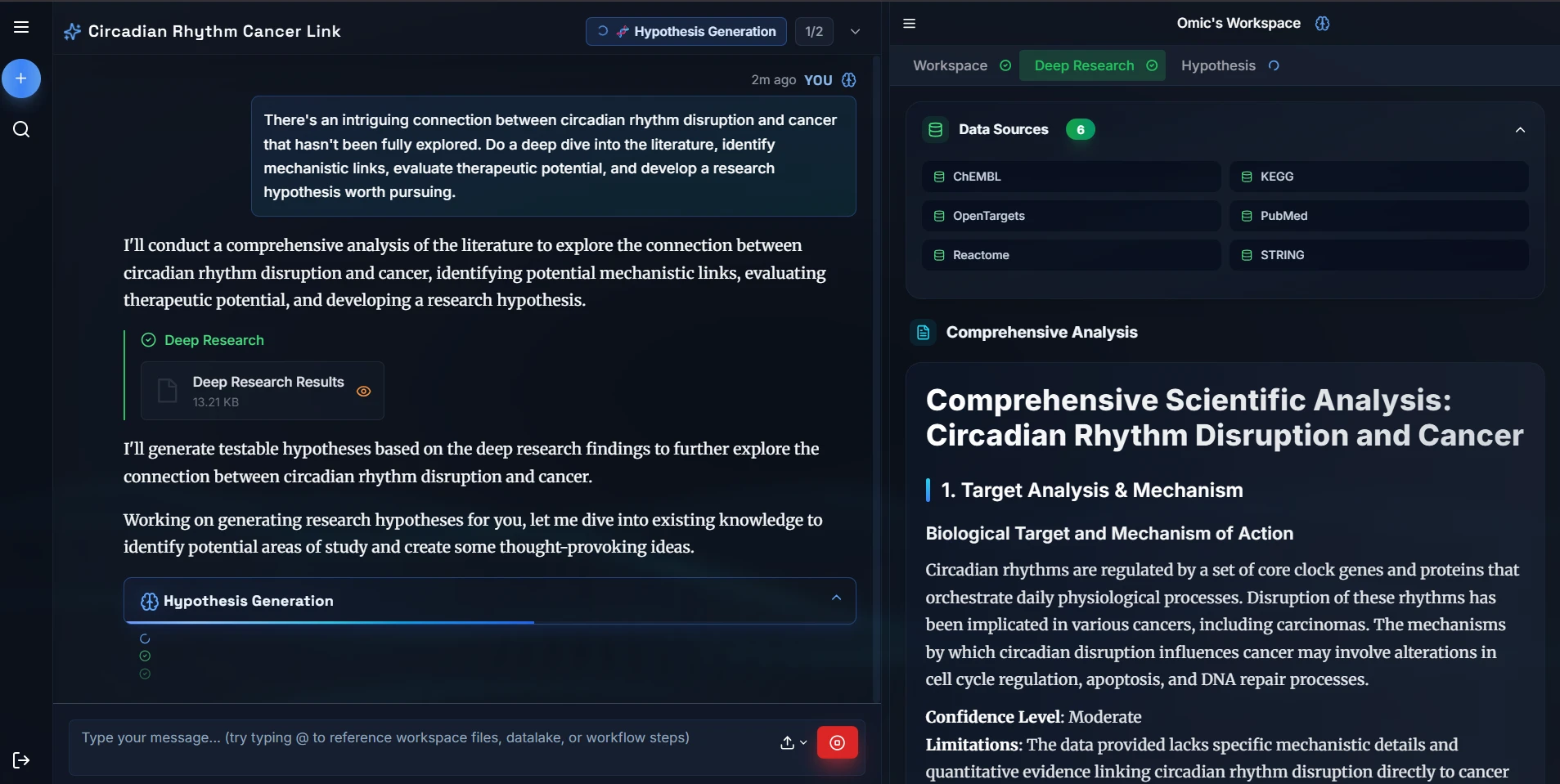
Our system doesn't wait for human direction. It forms its own hypotheses about disease mechanisms. It designs its own experiments to test them. It builds custom analytical tools when existing ones aren't sufficient. It writes up its findings in publication-ready manuscripts. It learns from each iteration and improves.
This is what we mean by biological superintelligence:
Not an AI that predicts. An AI that discovers. An AI that does the actual scientific work—autonomously, continuously, at a scale no human team could match.
Work that took our team months now takes hours. But more important than speed is scope. The AI explores hypothesis spaces we never would have considered. It finds patterns in data we would have missed. It makes connections across literature that no individual scientist could hold in their head.
Patients Before Patients
Understanding disease at the systems level means you can predict how it will respond to intervention. This is the foundation of our digital patient platform: mechanistic models that capture the actual molecular dynamics of pathology—how genes, proteins, and metabolites interact to produce disease states.
With these models, we can simulate drug response across diverse patient populations before synthesizing a single compound. We can identify which patients will respond best. Optimize dosing computationally. Test thousands of hypotheses in silicon. Discover which therapies will work before they enter clinical trials.
This is the power of systems biology combined with AI: not just finding targets, but understanding the complete causal chain from molecule to phenotype. Designing drugs that work with the body's existing regulatory networks instead of against them.
Precision medicine that's actually precise.
Where This Leads
We're building toward a future where understanding disease and designing therapies happens at a fundamentally different scale. Not incrementally better. Orders of magnitude better.
A future where rare genetic disorders get the same research attention as common diseases—because the cost of discovery no longer makes them economically impossible. Where pediatric cancers get dedicated therapies. Where tropical diseases get drugs.
A future where small molecule drugs are designed with such precision that they work with the body's own regulatory systems—cheap to manufacture, easy to take, accessible to everyone who needs them.
A future where the gap between understanding a disease and having a treatment for it shrinks from decades to years.
Our goal is to make undruggable diseases druggable. To cure what couldn't be cured. To give patients therapies that would never have existed otherwise.
That's what biological superintelligence means to us: AI that actually ends disease.
Join Us
We're building a team of scientists and engineers who want to work on problems that matter. If you believe AI can transform drug discovery—and you want to be part of making it happen—we want to hear from you.
View Open Positions