
Your organization’s
knowledge is its
most valuable asset.
AI that reasons end to end across the full R&D workflow: target hypotheses, protocol design, candidate selection, regulatory strategy. Not a point solution, an orchestration layer.
43 data connectorsqueried before the model reasons
Swipe to follow the pipeline →
Two teams derive the same result a year apart and neither ever knows. The work was done, paid for and recorded, and it still had to happen twice.
Built from the record up
A record that holds claims, not documents
Every assertion is its own row, carrying who made it, when, and what it rests on.
ProofThe Attest report ↗AttestDB is open source ↗
0 of 1,148 citations pointed at a record outside the question asked. Standard retrieval missed 32 of 4,156.
- assertedsilencing stops the tears
- contestedflavour never panel-tested
- extendedthree food-safe compounds
Your teams keep the tools. Your IP stays inside
People are already pasting unpublished methods into consumer chatbots, because that is where the useful tool is. Policy sits at the record, not at the person.
StatusIngress control is live. Reasoning and egress policy are on the roadmap.
Agents work the whole of R&D, on one state
Discovery through clinical, every stage reading the same record and writing its result back to it. A conclusion found in one program is available to the next question asked in another.
ProofTwo published runs, and the third path neither set out to find ↗
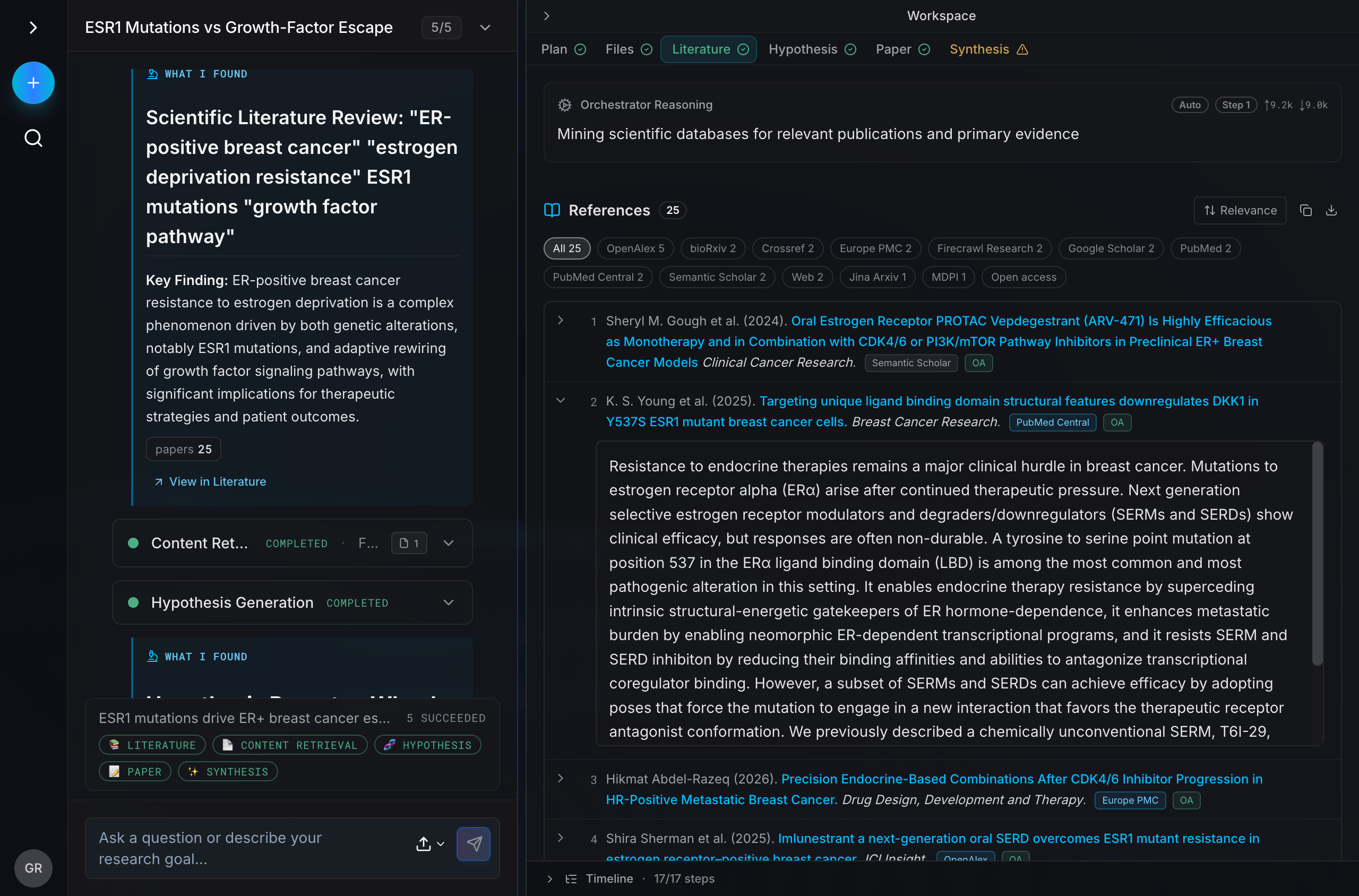
It arrives in the tool already open
Omic Discover for the full investigation, and the same fabric over MCP inside Claude and ChatGPT. Nobody is asked to move.
ProofSeven papers, a patent and 16 candidates from one archive ↗
Ask where you already work.
Answer from everything you know.
Can we stop onion tears without touching the onion?
The seven papers
Six are published in full below. The seventh is under double-blind review, and the patent will be shown once filed.
- technical reportAttest: a claim-native data layer for shared knowledge
- technical reportA survey of 3,974 archaeal biosynthetic gene clusters, and a substrate predictor for the fraction tools can see
- preprintMERIT: predicting trial outcomes from mechanism, not from compound memorization
- technical reportNear-cognate decoys hide partner identity in disordered-region benchmarks
- technical reportPRESTO: one model for binding affinity, and where it stops working
- technical reportSeven silent failure modes in genome-mining pipelines
- Under double-blind reviewTitle held until the review closes.