
Recorded in Discover
The accompanying clip shows source inspection and an experimental proposal from a breast cancer literature investigation. It is cropped to the workspace for readability. It does not show a new live run, experimental validation, automatic agent creation, or cross-project reuse. The run ended with citation and evidence-review caveats.
The exact research question
“Why do ER-positive breast cancers become resistant to estrogen deprivation? Compare the evidence for ESR1 mutations and growth-factor pathway escape. Use primary research, distinguish cell models from patient evidence, and propose one experiment that would tell these mechanisms apart. This is a literature-based investigation, not a request to download or analyze datasets.”
Check the source yourself
The paper visible in the recording is Young and colleagues, Breast Cancer Research, 2025, DOI 10.1186/s13058-024-01945-z. It studies a specific compound and ESR1-mutant breast cancer models. It is external research, not an Omic discovery or endorsement of the generated proposal.
Inspect the output
Open the full source-review capture or inspect the generated experimental proposal.
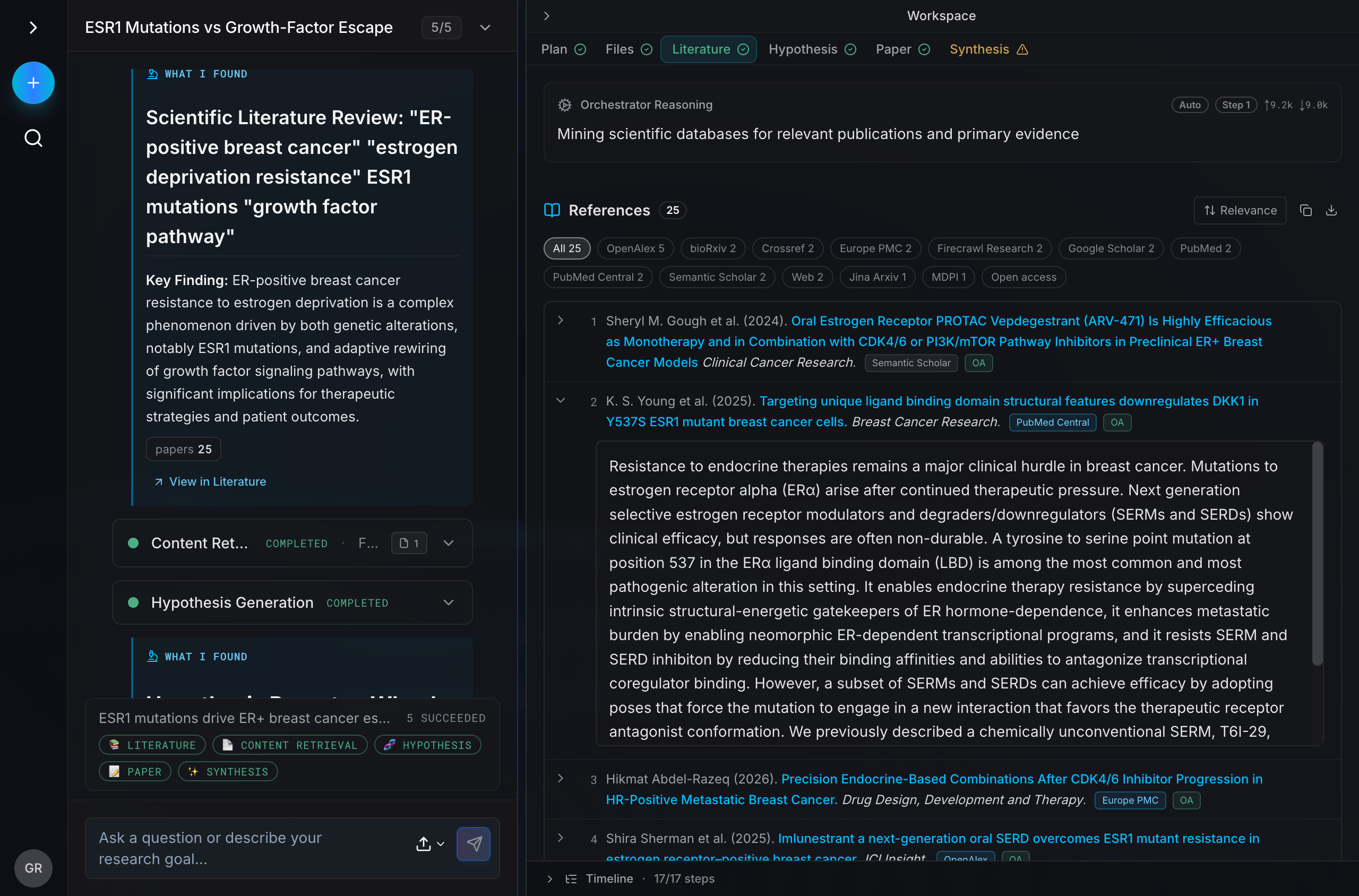
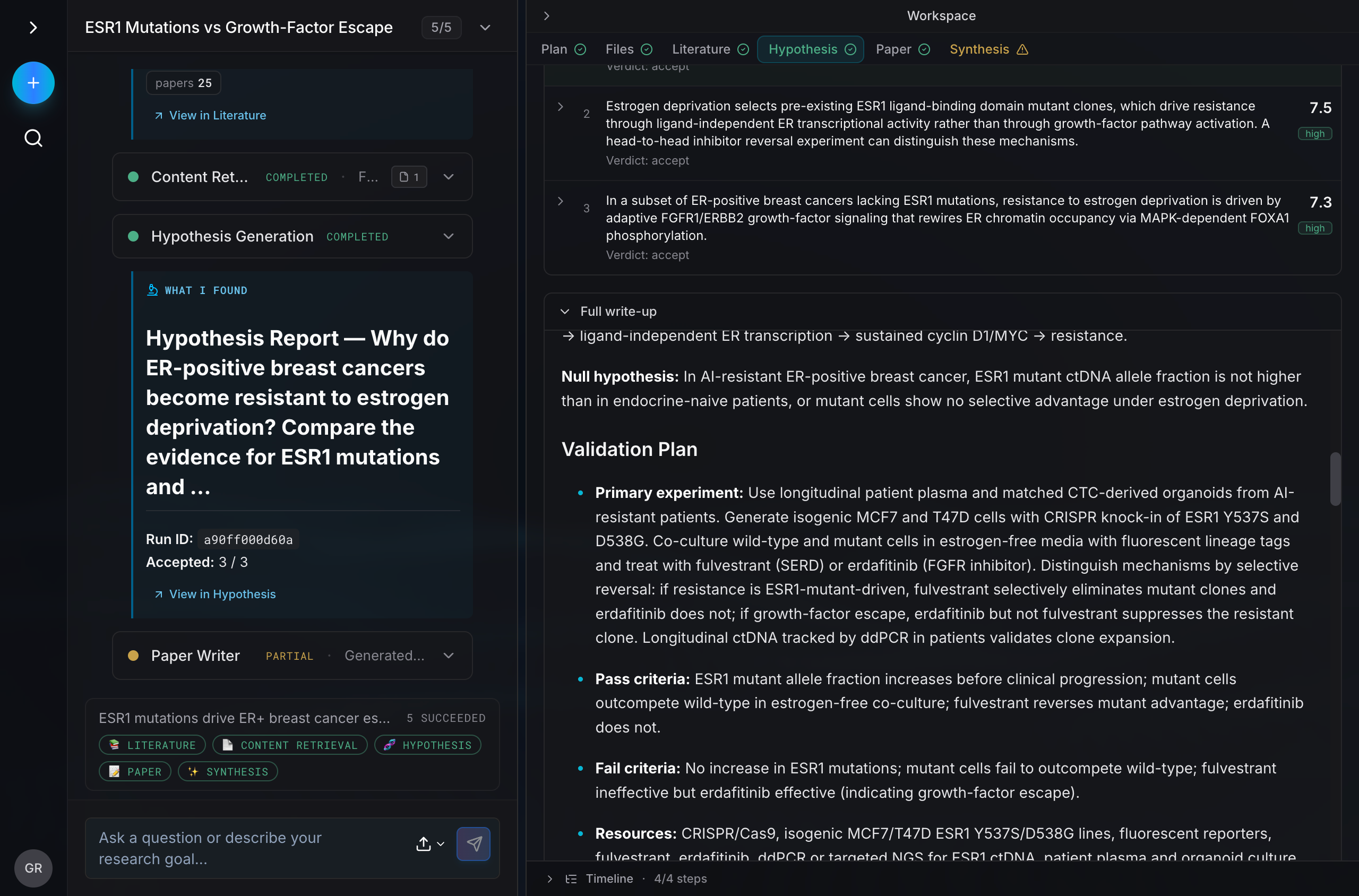
The proposal compares candidate resistance mechanisms and specifies an experiment and criteria for interpreting the result. It requires scientific review. The recording demonstrates inspection of research outputs, not experimental success or reuse across an organization. No biological discovery, treatment benefit, or calibrated confidence is established by this example.
How to frame your own investigation
A scientific investigation needs more than an answer. It needs a question with a defined scope, evidence that can be examined, and a next step that follows from what was actually found.
This guide describes a way to frame that work in Omic. It is a product guide, not a report of a new discovery.
Start with the decision
Instead of asking for everything known about a disease, describe the decision you are trying to make. Are you comparing candidate mechanisms, planning a data analysis, or choosing an experiment?
An example question: “Which mechanisms might explain resistance to a treatment, what evidence challenges each explanation, and which experiment would help distinguish them?” This is an illustrative prompt, not a completed investigation.
Include the relevant model or population, the data available, and the limits of the task. Evidence in a cell line may not answer the same question as evidence in patients.
Inspect the work behind the answer
For literature research, open the original sources. Check whether the study measured the outcome being discussed and whether its context matches your question. Keep the difference between a source’s finding and a proposed interpretation visible.
For data analysis, inspect the inputs, methods, code, and outputs. A planned analysis is not an executed analysis. Ask whether the comparison is supported by the available data and what assumptions the method introduces.
Explore Omic’s research workflows.
Make the next step falsifiable
A useful hypothesis should identify what would make you reconsider it. Compare alternative explanations and specify an experiment whose possible outcomes would distinguish them.
Computational evidence can help prioritize that experiment. It does not, by itself, establish experimental validation, clinical efficacy, or a therapeutic window.
Keep the evidence available for the next question
When a source changes or a conflicting finding appears, the original conclusion may need review. Preserving the relationship between a claim and its evidence makes that review easier to reason about.
Try our illustrative evidence demonstration, or read the AttestDB technical documentation. The demonstration uses synthetic evidence and does not represent a live research result.
Bring your own question
Omic combines AI-assisted literature investigation, data analysis, hypothesis development, and research artifacts in a scientific workspace. We are preparing launch access. Join the launch list or discuss a research evaluation with the team.