
The argument
An organization that wants its members to work from shared knowledge gives them shared documents. Each reader extracts what those documents say, weighs it, notices or misses disagreement between sources, and keeps the result in a form others cannot query. Two analysts reading one corpus produce two summaries that cannot be compared, merged or audited, because the summaries share no unit of identity.
A shared record has to answer four questions about every fact it holds: who asserted it, when, how strongly it should be believed, and whether it still stands. Document stores answer none of them at the storage layer.
What Attest does
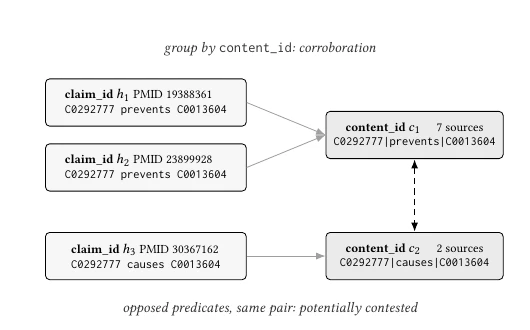
Figure 1. Each source's assertion is its own row. Two sources asserting 'prevents' group into one proposition with seven sources; a third asserting 'causes' over the same pair forms an opposed predicate, which is how a contested claim becomes visible rather than averaged away.
One row per source assertion, with two content hashes: one for the proposition, one for each source's assertion of it. The proposition hash becomes the storage layer's grouping key, so counting sources is a group-by and contested propositions are found by grouping on opposed predicates.
Claims carry provenance, confidence, and status. A retracted source produces a status change rather than a deletion, so what was believed before the withdrawal, and on whose authority, remains queryable. Writes extend a SHA-256 chain over claim identifiers, so a reordered or altered write sequence is detectable.
What was measured
- Attribution. On 150 opposed-predication pairs (median pool 2,960 statements), the claim store cites no record from outside the pair, 0 of 1,148, against 32 of 4,156 for source-tagged top-130 retrieval and 323 of 2,754 for reading the whole pool. Restricting to the two opposed predicates reaches 0.99 minority recall and 0.85 exact recovery.
- The cost of structuring. On a 50-paper corpus, a vector index builds for $0.009 against $1.39, answers at a quarter of the price in under half the time, and recovers more gold figures (15 of 16 against 10 to 13). There is no break-even against the vector index on cost.
- Write-path instability. Two extraction builds of the same corpus share 18% of their propositions. Propositions asserted by more papers were more often rebuilt: 30%, 83% and 94% for one, two, and three or more sources.
What this does and does not show
This is a vision paper with preliminary results. A shared claim store can be copied and replayed reliably, but has not been independently re-derived. Withdrawal is recorded but does not propagate end to end: tracing a claim to its retracted source requires a link from DOI to stored source, which the system computes rather than persists. Which later claims a retraction should affect, given independent support, is not yet defined.