
The question
Most of the human proteome lacks small-molecule binding pockets, so the protein-protein interactions governing those proteins are an attractive modality. Development against them depends on affinity. PRODIGY, the established contact-based predictor, reports RMSE 1.89 kcal/mol on its own benchmark but reaches 3.87 on our crystal structures, roughly 700-fold uncertainty in K_d. A prediction of 100 nM is equally consistent with a potent drug and an inactive compound.
What PRESTO is
Gradient-boosted trees over 93 engineered biophysical features, paired with an ensemble of 14 interface cross-attention networks over three protein language models. One model, evaluated on all three tasks practitioners actually face.
What it found
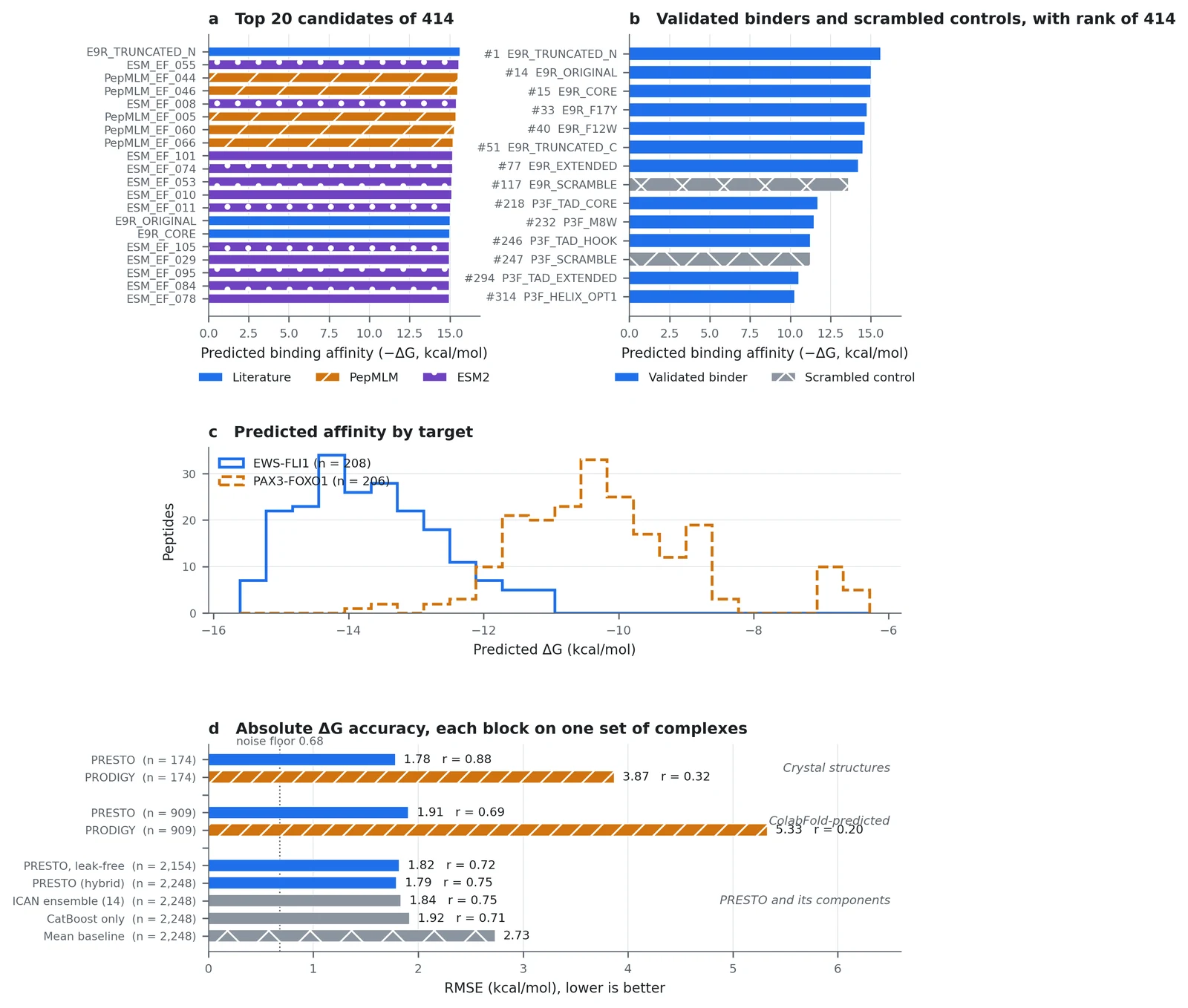
Figure 1. Ranked candidates and validated binders against scrambled controls, predicted affinity by target, and absolute accuracy: PRESTO 1.78 kcal/mol (r = 0.88) against PRODIGY 3.87 (r = 0.32) on crystal structures, 1.91 against 5.33 on predicted ones. Note panel b: a scrambled control still ranks 117th of 414, which is the kind of result the paper reports rather than hides.
- Absolute affinity on natural complexes. RMSE 1.82 kcal/mol (r = 0.72) over 2,154 complexes under 5-fold cross-validation grouped by PDB identifier. Against PRODIGY on complexes both methods score: 1.78 against 3.87 on 174 SKEMPI complexes with crystal structures, 1.91 against 5.33 on 909 PPB-Affinity complexes.
- An applicability domain that was measured, not assumed. Accuracy degrades where the target is unrelated to any training target: 1.56 where the target appears in another complex, 1.93 for the 686 complexes whose family appears in no other fold. That last figure is the one describing prospective use against an unfamiliar target.
- Two negative results, reported as findings. An absolute affinity does not rank designed binders, and combining it with structural confidence makes selection worse; an objective trained on design outcomes composes with confidence instead. Mutational effects need a separate additive term. Structural confidence, absolute affinity and mutation effects carry different information and do not substitute for one another.
- On a 414-peptide screen, the absolute predictions are wrong by five orders of magnitude. The top-ranked peptide is predicted at 3.6 pM against a literature value of 2.3 µM. Ranking signal partly survives outside the applicability domain; the absolute scale fails.
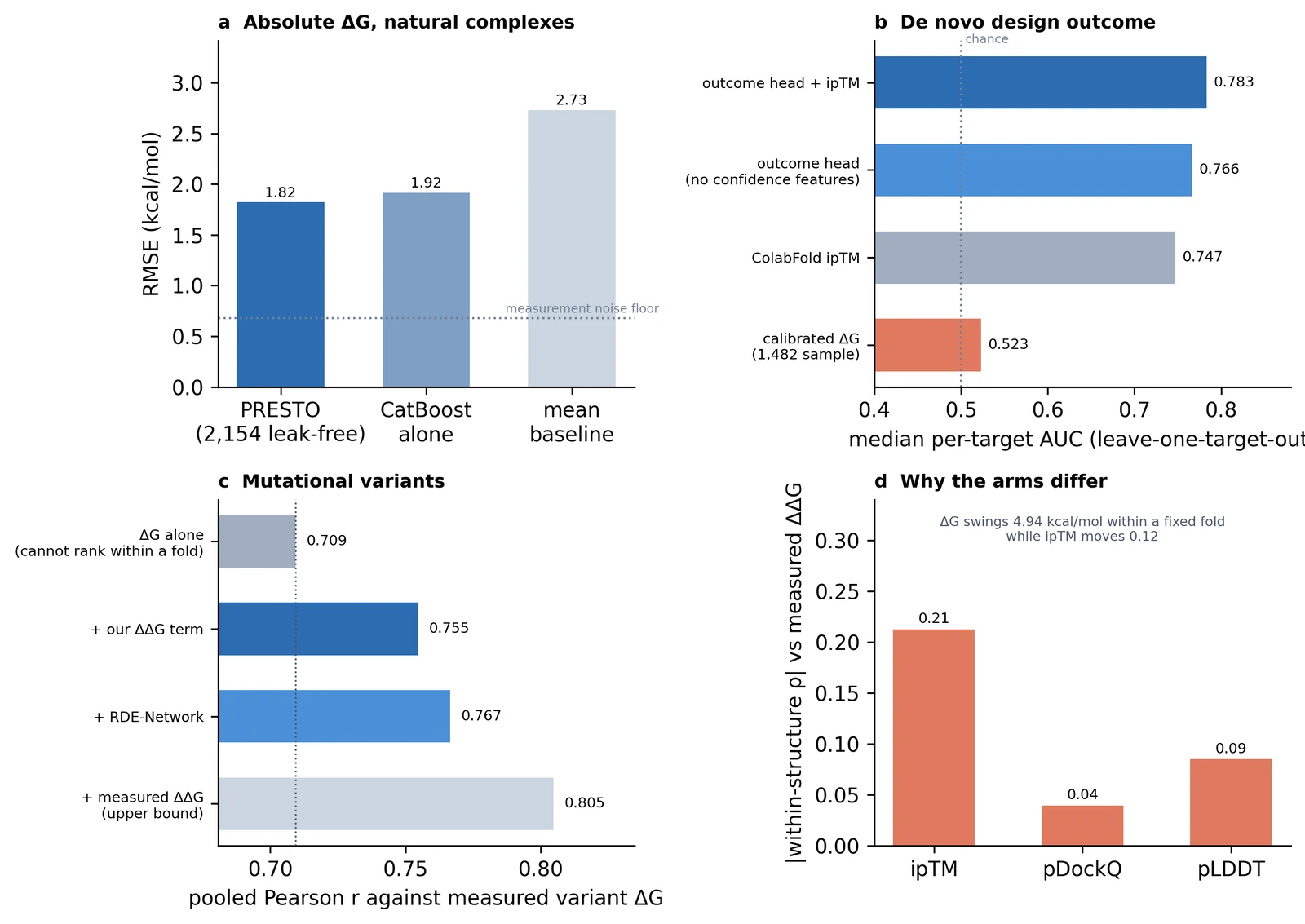
Figure 2. Coverage across the three binding questions. (a) Absolute delta-G on natural complexes: PRESTO against PRODIGY on the complexes both score, with the measurement noise floor marked. (b) Design outcome, median per-target AUC over 12 targets. (c) Mutational variants, pooled Pearson over 2,119 variants. (d) Why the arms differ: affinity swings 4.94 kcal/mol within a fixed fold while ipTM moves 0.12.
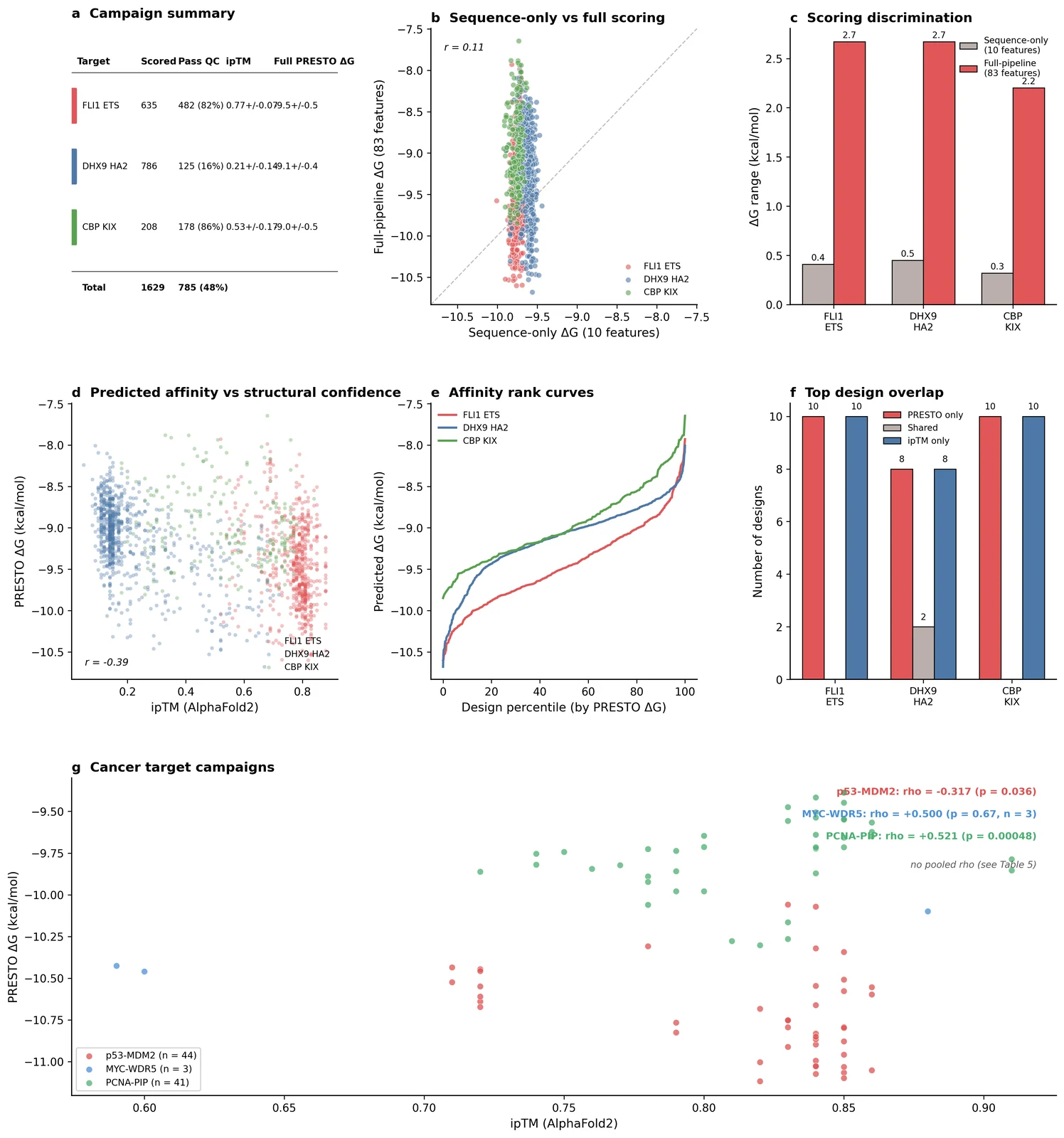
Figure 3. Prospective design campaigns: 1,629 designs across three pediatric targets. (b) The sequence-only score available inside the design loop is nearly unrelated to the full-pipeline score used to rank, so the score guiding design is not the score selecting. (f) Top-ten overlap between PRESTO and ipTM is zero of ten on two of the three targets. No design here has been synthesised or assayed.
What this does and does not show
Every figure is a development estimate: model selection and performance estimation share the same complexes, so the optimism cannot be removed by reweighting. A leakage-free refit of the tabular arm gives RMSE 1.945 against 2.067, locating 0.122 kcal/mol as legitimate contribution and 0.022 as leakage. Independent measurements of the same complex differ by 1.79 kcal/mol RMSE, which the paper examines as a possible noise floor and concludes the data do not support. No prospective experimental validation has been run.